The Bizarre Report #01, Classic Movie Monsters and the True Folklore Behind Them
CASE FILE CLASSIFIED
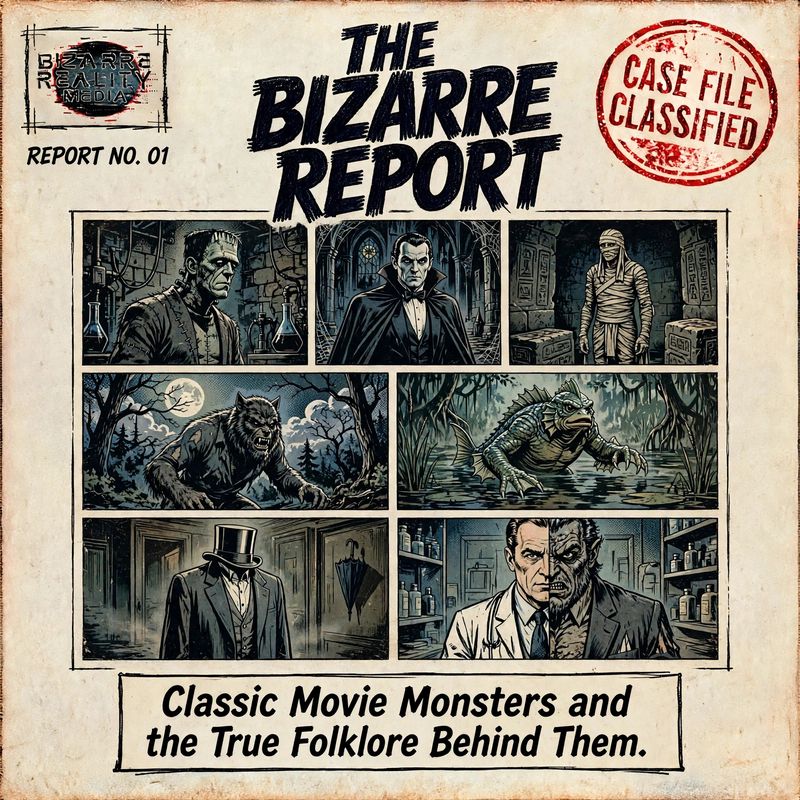
I'm a millennial, so I didn't grow up when these films were new. I grew up finding them later, on late-night television and old VHS tapes and old discs and whatever I could track down, not the modern, fast-cut versions, but the old ones in black and white, where the monster moves slowly and the camera stays on it a little too long. What I didn't know then was how much older the ideas were than the movies. Hollywood didn't invent these creatures out of thin air. It borrowed them, dressed them up, and in a few cases, completely rewrote what they were supposed to be.
So let's go back through seven of them, and separate what the movies gave us from what the folklore, the science, and the history actually say. Some of it holds up better than you'd expect. Some of it falls apart the second you look at it closely. That's the part I like.
The creature who was never called Frankenstein
Start with the one everybody gets wrong, including me, for years.
In Mary Shelley's novel, published in 1818 as Frankenstein; or, The Modern Prometheus, Frankenstein is the creator, not the creature. Victor Frankenstein is a young scientist obsessed with the secret of life. The creature he builds has no name in the book. He's intelligent, he learns language, he reads, he argues with his creator about responsibility and abandonment. He's not the grunting, bolt-necked figure from the 1931 Universal film, played by Boris Karloff, with a flat head and a lumbering walk. That image came later, from the movies, from stage versions, and from a century of posters copying each other.
So where did Shelley get the idea? She wrote the first draft in the summer of 1816, the so-called Year Without a Summer, when the eruption of Mount Tambora had darkened skies across Europe. She was staying near Lake Geneva with Lord Byron, Percy Bysshe Shelley, and John Polidori, and Byron proposed they each write a ghost story. Shelley's story grew out of conversations about galvanism, the idea that electricity could animate dead tissue.
That part is real science history, even if the leap to a living man is not. In the 1780s, Italian physician Luigi Galvani found that a dead frog's legs twitched when touched with metal instruments during electrical experiments. His nephew, Giovanni Aldini, took it further in public demonstrations, including one in London in 1803 on the body of an executed murderer, George Forster. Witnesses reported the jaw moving, an eye opening, a hand clenching. Aldini did not bring Forster back to life. What he showed was that electricity can make dead muscle contract, which is a very different claim, and one that newspapers of the time were happy to exaggerate.
There's also an older story underneath Frankenstein, and it's one I think matters more than the electricity. The golem of Prague is a Jewish folk legend about Rabbi Judah Loew ben Bezalel, in the 16th century, who is said to have shaped a figure from clay and brought it to life to protect the Jewish community in Prague. The word emet, meaning truth, was written on its forehead, or placed in its mouth in some versions. Erase the first letter, and you get met, meaning dead, and the golem stops. That's not a documented historical event. It's legend, passed down and retold, and it asks the same question Shelley's novel asks: if you can make something that lives, what do you owe it?
What holds up here? Shelley was writing in a real moment, when anatomy, grave-robbing for medical schools, and electrical experiments were all in the news, and when people were genuinely arguing about where life comes from. What doesn't hold up is the movie version as history. There was no Victor Frankenstein, no castle laboratory that stitched together a man from graveyard parts and brought him to life with lightning, and no creature with bolts in his neck. The bolts, by the way, are a movie invention, usually explained as electrodes. Shelley never describes them.
My take is simple. Frankenstein endures because it's not really about a monster. It's about a creator who walks away. The creature in the book is frightening because he's abandoned and angry, not because he's stupid or mindless. Hollywood made him easier to sell and harder to understand.
The count who was not Vlad, exactly
No monster is more recognisable than Dracula, and no monster has been rewritten more often. Bram Stoker published Dracula in 1897. His Count is an old Transylvanian nobleman who buys property in England, feeds on the living, and is fought by a group led by Professor Van Helsing, using garlic, crucifixes, holy water, and a wooden stake. The 1922 German film Nosferatu copied the story without permission, renamed the Count to Orlok, and gave him a rat-like, plague-carrying look. Universal's Dracula in 1931, with Bela Lugosi, gave us the cape, the accent, the formal manners, and the line about listening to the children of the night. Lugosi's performance is so strong that most people now picture Dracula and hear Lugosi at the same time, even if they've never read Stoker.
So was Dracula Vlad the Impaler? Yes and no, and the distinction matters. Vlad III, who ruled Wallachia in the 15th century, was called Dracula, meaning son of Dracul, because his father, Vlad II, belonged to the Order of the Dragon. Vlad III was famous, and feared, for impaling his enemies, and for a brutal, effective style of warfare against the Ottoman Empire. He was not, in life, a vampire. Stoker borrowed the name, and he borrowed the region, and he read about Vlad in historical sources available to him in England. Whether Stoker meant Dracula to be Vlad himself, reborn as a vampire, or simply borrowed a striking name for a fictional count, is debated by scholars. What is documented is the name borrowing. What is not documented is a direct, one-to-one biography, where the historical Vlad becomes the fictional Count in a straight line.
The folklore underneath Dracula is older and messier than the novel. Across Eastern Europe, there were beliefs about the dead returning, about bodies that did not decay properly, about the strigoi in Romanian tradition, and about revenants who drained life from the living or from livestock. The details varied by village and by century. Some revenants were blamed for disease, some for bad harvests, some for nightmares and sleep paralysis. Staking, beheading, and burning were folk remedies for a corpse that was thought to be active, not courtroom procedures with a clear rulebook. Garlic, mirrors, and sunlight, as a fixed set of vampire weaknesses, are largely Stoker and later film inventions, assembled into a system that folklore never had in one place. In folklore, a vampire might be repelled by garlic in one account and not mentioned in another. Sunlight killing a vampire outright is mostly a film idea, cemented by Nosferatu, where Orlok dissolves in dawn light. Stoker's Dracula is weakened by daylight, but he can still move in it.
There's also a modern explanation that gets repeated too confidently, and I want to flag it. Porphyria, a group of blood disorders that can cause sensitivity to sunlight, receding gums, and other symptoms, is sometimes offered as the real origin of vampire folklore. It's an interesting parallel, and it's been suggested in popular writing, but it's speculation, not an established origin. Vampire folklore predates modern diagnosis by centuries, it covers far more than porphyria symptoms, and most scholars who study folklore do not treat porphyria as the source. I would not bet on it.
What holds up? Stoker really did borrow a historical name and a region, Eastern European folklore really did include revenants and folk remedies for the restless dead, and Vlad III really was a brutal 15th-century ruler known for impalement. What doesn't hold up is the idea that Dracula is Vlad, or that folklore gave us a single, consistent vampire with a cape, a castle, and a checklist of weaknesses. Hollywood and Stoker built that system. Folklore gave them the raw material.
My take: Dracula works because he is polite. Frankenstein's creature is abandoned and angry. Dracula invites himself in, he dresses well, he speaks well, and he asks for permission, in a sense, to enter your house. That's a different kind of horror, and it's why the Count outlived the novel. He doesn't break in. He gets invited.
The man who did not need a full moon
If Dracula is polite horror, the Wolf Man is guilt horror. Universal's The Wolf Man, from 1941, with Lon Chaney Jr. as Larry Talbot, gave us almost everything we now associate with werewolves in movies. Talbot is bitten by a wolf, or by a man who is a wolf, he develops a pentagram mark, he transforms, and he can only be killed by a silver bullet, or by a silver-headed cane in the film's case. The film also gave us the poem, spoken by the gypsy woman Maleva: "Even a man who is pure in heart, and says his prayers by night, may become a wolf when the wolfbane blooms, and the autumn moon is bright." That's a film poem, not an old folk rhyme. Wolfbane, the pentagram, and the silver bullet as a fixed rule set are largely Universal inventions, assembled for the movie and then copied so often they feel ancient.
The folklore underneath is older, and it's not about the moon in the way the movies suggest. In Greek myth, King Lycaon is turned into a wolf by Zeus as punishment for impiety, for serving human flesh at a feast in some versions. That's a punishment transformation, not a curse passed by a bite. In Norse tradition, berserkers and ulfhednar, wolf-coated warriors, wore animal skins and fought in a frenzy, which is a warrior tradition, not a monthly transformation. In medieval Europe, there were werewolf trials, and the most famous is Peter Stumpp, from Bedburg in Germany, who was executed in 1589 after confessing to killing and eating people as a wolf, and to other crimes. His confession was obtained under torture, and the pamphlets about his case were sensational, so the trial record is not reliable evidence that Stumpp transformed. It is reliable evidence that people in that time and place believed transformation was possible, and that belief could get you killed.
In much of the older folklore, transformation was often voluntary, or at least not tied to a full moon. A person put on a wolf skin, or a belt, or rubbed on an ointment, or made a pact, and became a wolf. The full moon as a trigger, the idea that a good man loses control once a month, is a modern, cinematic simplification. It works for a film because it gives you a calendar, a countdown, and a tragedy you can schedule. Folklore was messier. Sometimes the wolf was a man who chose it. Sometimes it was a punishment. Sometimes it was a delusion, which modern medicine calls clinical lycanthropy, where a person believes they are transforming into an animal. That's a psychiatric condition, not a physical transformation, and it's rare.
What holds up? People have told wolf-transformation stories for thousands of years, from Lycaon to Norse wolf warriors to medieval trials, and those stories reflect real fears about violence, about losing control, and about the wild at the edge of a village. What doesn't hold up is the Universal rulebook as folklore. Silver bullets, pentagrams, wolfbane, and a full-moon trigger as a package are film inventions, not a folk system.
My take: the Wolf Man is scary for a different reason than Dracula. Dracula chooses to feed. Talbot doesn't choose to transform, at least in the film, and he wakes up with no memory of what he did. That's guilt without control, and that's a horror most people understand, even if they've never believed in a werewolf.
The mummy who was never meant to walk
The 1932 Universal film The Mummy, again with Boris Karloff, gave us Imhotep, an ancient Egyptian priest who is mummified alive as punishment, then revived in the modern world and searching for his lost love, reincarnated as a modern woman. It's a great story. It's also almost entirely invented.
Real Egyptian mummification was not a punishment, and it was not meant to create a walking corpse. It was a careful, religious preparation for the afterlife. The body was washed, the internal organs, except for the heart, were removed and preserved separately, often in canopic jars, and the body was dried with natron salt for around 70 days, then wrapped in linen, with amulets placed between the layers. The point was preservation, not reanimation. Egyptians believed in parts of the soul, including the ka, a kind of life force, and the ba, often pictured as a bird with a human head, which could travel between the world of the living and the afterlife. The dead were supposed to live on in another realm, guided by spells in what we call the Book of the Dead, more accurately the Book of Coming Forth by Day. They were not supposed to get up and walk through a museum.
So where did the walking mummy come from? A large part of it came from the tomb of Tutankhamun, discovered in November 1922 by Howard Carter, funded by Lord Carnarvon. Carnarvon died in April 1923, about five months after the tomb was opened, from an infected mosquito bite that led to blood poisoning and pneumonia. That's the documented cause. Newspapers, hungry for a story, built a curse around it. Other deaths connected to the tomb over the following years were added to the list, often without noting how many people connected to the excavation lived long, ordinary lives, or how common early deaths were in that era for other reasons. Arthur Conan Doyle, the creator of Sherlock Holmes, publicly suggested a supernatural element, which gave the story more weight than it deserved. The curse, as a coherent, killing force, is a media creation, not an Egyptian one. Egyptians did place warnings and curses on some tombs, but those were about theft and desecration, not about a mummy rising to take revenge centuries later.
What about Imhotep himself? There was a real Imhotep, but he lived around 2650 BCE, he was an architect and physician under Pharaoh Djoser, credited with designing the Step Pyramid at Saqqara, and he was later deified as a god of medicine. He was not a priest punished by mummification alive, and he was not searching for a reincarnated lover. The film borrowed his name and built a new character around it.
What holds up? The Egyptians really did believe the dead needed their bodies preserved, they really did write spells for the journey after death, and they really did take tomb robbery seriously. What I would not bet on is any account of a mummy walking, or of a curse that systematically killed the people who opened Tutankhamun's tomb. The numbers don't support it when you look at the whole group, not just the famous deaths.
My take: the mummy is scary in the movies because it makes death look unfinished. The real Egyptian idea is, in a way, stranger and more interesting. Death wasn't an ending to be reversed with a walk through a museum. It was a journey that needed preparation, and the body was the vehicle for that journey, not a weapon.
The creature from a river that might hide something
Creature from the Black Lagoon, from 1954, is the odd one out in the Universal lineup, because it's not based on a famous novel. A scientific expedition in the Amazon finds a fossilised hand, then a living Gill-man, a prehistoric amphibious creature, in a remote lagoon. He's presented as a missing link, a survivor from the Devonian period, hundreds of millions of years ago, and he becomes fascinated, in the film's telling, with the expedition's female scientist.
There's no documented Gill-man in the Amazon, and no fossil hand like the one in the film. But there are two real threads underneath it that are worth pulling.
The first is the coelacanth. For a long time, scientists believed coelacanths had gone extinct with the dinosaurs, about 66 million years ago. Then, in 1938, a living coelacanth was caught off the coast of South Africa. It was a fish that was supposed to be a fossil, and it was still swimming. That doesn't prove a Gill-man exists. What it proves is that our fossil record is incomplete, and that remote waters can hide animals we thought were gone. The Amazon is vast, poorly surveyed in places, and new species are still being found there, mostly fish, frogs, and insects, not human-sized amphibious men. The leap from a living fossil fish to a Gill-man is a big one, and I wouldn't make it without a body, a clear photograph, or a skeleton that holds up to examination.
The second thread is folklore, and it's more specific than people usually realise. In Amazonian tradition, there is the boto, the pink river dolphin, which in legend can transform into a handsome man, often dressed in white, who seduces women at festivals and then returns to the river. That's not the Gill-man, and the boto legend is not a report of a scaly monster in a lagoon. It's a story about a river animal that crosses into human form, about desire, and about the danger of the river at night. But it shows that Amazonian folklore already had a shape-shifting river being long before Hollywood arrived. The film took the setting, the remoteness, and the idea of something ancient in the water, and turned it into a monster suit, played by Ricou Browning in the underwater scenes, which, to be fair, still holds up as a piece of design.
What holds up? Remote rivers can hide real animals, and river folklore in the Amazon is rich with beings that move between water and land. What doesn't hold up is the film's creature as a biological fact. No Gill-man skeleton, no verified sighting that survives scrutiny, and no expedition that brought one back.
My take: the Creature works because water is the one place where we still can't see everything. You can map a forest from the air. You can't see clearly through a dark lagoon. That gap is where folklore lives, and Hollywood knew exactly how to use it.
The man you can't see, and the old stories about disappearing
H.G. Wells published The Invisible Man in 1897. His character, Griffin, is a scientist who discovers a way to make his body transparent by changing its refractive index to match air, so light passes through him instead of bouncing off. He goes mad, in part because invisibility doesn't make life easier. He can't eat without being seen, because food in his stomach becomes visible until it's digested. He can't walk in rain or snow without leaving footprints or a shape. He has to go naked to stay invisible, which in Victorian England is a problem on its own.
Wells was onto a real scientific problem, even if he solved it with fiction. If your eyes were truly transparent, light would pass straight through them, and you wouldn't be able to see. Your retina needs to absorb light to form an image. A perfectly invisible person would be blind, which is a detail most movie versions quietly ignore. Modern work on invisibility cloaks, using metamaterials to bend light around an object, is real research, but it's limited, it works for specific wavelengths and angles, and it's a long way from a man walking down a street unseen.
The folklore underneath invisibility is much older than Wells. In Germanic legend, the Tarnkappe is a cloak or cap that makes its wearer invisible. Siegfried uses one in the Nibelungenlied. In Greek myth, Perseus borrows the helmet of Hades, also called the Cap of Darkness, to kill Medusa without being seen. In Plato's Republic, the Ring of Gyges makes a shepherd invisible, and Plato uses it to ask a moral question: if no one could see what you did, would you still act justly? That's the same question Wells asks, in a different form. Griffin doesn't become evil because he's invisible. He becomes dangerous because invisibility removes consequences, and he likes that.
What holds up? The folklore is consistent across cultures: invisibility is almost never a gift without a cost. What doesn't hold up is Wells's method as a practical science. Changing a body's refractive index to match air, for all tissues, all at once, and keeping the eyes working, is not a procedure waiting to be discovered. It's a thought experiment, and a good one.
My take: the Invisible Man is the most honest monster of the bunch, because his horror isn't about what he looks like. It's about what a person does when they think no one is watching. That's not folklore. That's human nature, and it's why the story still works.
The doctor who split himself in two
Robert Louis Stevenson's Strange Case of Dr Jekyll and Mr Hyde, published in 1886, is often filed with the monster movies, and for good reason. Universal and Hammer both adapted it, and the idea of a respectable doctor who drinks a potion and becomes a violent, ape-like alter ego is now part of the language. We call someone a Jekyll and Hyde when they seem like two different people.
Stevenson said the story came to him in a dream, and he wrote the first draft in a few days. That's his account, and it's plausible for a writer who worked fast, but it's not the whole story. Edinburgh, where Stevenson grew up, had a real figure who lived a double life: Deacon Brodie, a respected cabinetmaker and city councillor by day, who by night burgled the houses of his own customers, using keys he had copied while doing repair work. Brodie was caught and hanged in 1788. Stevenson knew the story, and Edinburgh tradition links Brodie to Jekyll and Hyde, though it's a claimed inspiration, not a proven one-to-one source. Stevenson never said Brodie was Jekyll, and the novel is not a retelling of Brodie's life. It's a story that uses a real city's double life as atmosphere.
The folklore underneath Jekyll and Hyde is the doppelganger, a German word for a double, a second self that appears as a kind of shadow or twin. In folklore, seeing your own double is often treated as an omen, not as a friendly twin. It's not a ghost, and it's not a separate spirit in the way a haunting is usually described. It's you, split off, and that split is the horror. Modern psychology would talk about dissociation, about repression, about the parts of ourselves we hide in public and act out in private. Stevenson didn't have that language, but he had the story, and the story does the same work.
What holds up? People do live double lives, and Deacon Brodie is a documented example. What doesn't hold up is the potion as chemistry. There is no drug that splits a person into a good doctor and a violent alter ego with a different face and body. The transformation in the movies, with makeup and hunched posture, is theatre, not pharmacology.
My take: Jekyll and Hyde endures because it's not about a monster you can run from. It's about the version of you that shows up when no one you respect is watching. That's closer to home than a lagoon or a tomb, and that's why it still makes people uncomfortable.
Why these old monsters still work
Here's what ties these seven together, for me. Frankenstein, Dracula, the Mummy, the Wolf Man, the Creature, the Invisible Man, and Jekyll and Hyde all started as questions, not as costumes. Can we make life? What feeds on the living, and why do we invite it in? What happens after death? What lives in water we can't see through? What do we do when we lose control? What would we do if we couldn't be seen? What if the monster is us?
Hollywood gave each question a face, a walk, and a poster. Folklore gave each question a history, sometimes a real one, sometimes a legend that was told so often it felt real. The movies are not reliable history, and the folklore is not reliable science. But when you put them side by side, you get something better than either one alone. You get a story that tells you what people were afraid of, what they hoped science could do, and what they were willing to believe when the lights were low.
That's why I keep going back to the old monsters. Not because I think a mummy is going to walk out of a museum, or a Gill-man is waiting in a lagoon, but because the questions underneath them haven't gone away. We've just given them new costumes.
If you want the full sources for each section, they're below. Read them, argue with them, and tell me where you think I'm wrong. That's the point of this series. I'm not here to hand you a finished answer. I'm here to show you the trail, and let you follow it yourself.
Sources
- Mary Shelley, Frankenstein; or, The Modern Prometheus (1818). First edition text and Shelley's 1831 introduction on the Villa Diodati ghost-story competition and the summer of 1816. - Luigi Galvani, experiments on animal electricity, 1780s, and Giovanni Aldini, An Account of the Late Improvements in Galvanism (1803), including the London demonstration on George Forster. - Golem of Prague legend, Rabbi Judah Loew ben Bezalel, 16th century, as recorded in later Jewish folk collections. Legend, not a documented historical event. The emet / met wordplay is part of the folk tradition. - Universal Pictures, Frankenstein (1931), directed by James Whale, Boris Karloff as the Creature. Film design, including flat head and neck electrodes, is a film invention, not from Shelley's novel. - Egyptian mummification practice: washing, organ removal except for the heart, natron drying for around 70 days, linen wrapping with amulets. Book of Coming Forth by Day, commonly called the Book of the Dead, spells for the afterlife. Concepts of ka and ba in Egyptian religion. - Howard Carter, discovery of Tutankhamun's tomb, November 1922. Lord Carnarvon, death April 1923, from an infected mosquito bite leading to blood poisoning and pneumonia. Contemporary newspaper coverage of a tomb curse, including Arthur Conan Doyle's public comments, as media history, not as evidence for a curse. - Real Imhotep, architect and physician under Pharaoh Djoser, around 2650 BCE, credited with the Step Pyramid at Saqqara, later deified as a god of medicine. Distinct from the film character in The Mummy (1932). - Universal Pictures, The Mummy (1932), directed by Karl Freund, Boris Karloff as Imhotep / Ardath Bey. Film plot is invented, not Egyptian history. - Universal Pictures, Creature from the Black Lagoon (1954), directed by Jack Arnold. Gill-man as a Devonian survivor is a film premise, not a fossil record claim. - Coelacanth, thought extinct for about 66 million years, living specimen caught off South Africa in 1938. Used here as a parallel for incomplete fossil knowledge, not as evidence for a Gill-man. - Boto, pink river dolphin, Amazonian folklore of transformation into a human man. Folklore, not a zoological report. - H.G. Wells, The Invisible Man (1897). Griffin's refractive-index method and its practical problems, including food visibility and the problem of transparent eyes. - Tarnkappe in the Nibelungenlied, Siegfried's cloak of invisibility. Helmet of Hades in Greek myth, borrowed by Perseus. Ring of Gyges in Plato's Republic, Book II, as a moral thought experiment. - Robert Louis Stevenson, Strange Case of Dr Jekyll and Mr Hyde (1886). - Deacon Brodie, Edinburgh cabinetmaker and councillor by day, burglar by night, hanged 1788. Claimed local inspiration for Stevenson, not a proven direct source for Jekyll and Hyde. - Doppelganger folklore, German tradition of a double or second self, often treated as an omen. Folklore, not a medical diagnosis. - Bram Stoker, Dracula (1897). Vlad III, Voivode of Wallachia, 15th century, called Dracula as son of Dracul, Order of the Dragon, known for impalement. Name borrowing by Stoker is documented; a direct biography of Vlad as Dracula is debated, not established. Nosferatu (1922), Count Orlok, unauthorised adaptation of Stoker. Universal Pictures, Dracula (1931), Bela Lugosi. Sunlight killing, garlic, mirrors, and staking as a fixed system are largely Stoker and film inventions, not a single folklore rulebook. Porphyria as vampire origin is modern speculation, not an established origin. - Universal Pictures, The Wolf Man (1941), Lon Chaney Jr. as Larry Talbot. Pentagram, wolfbane, silver bullet, and the Maleva poem as a package are film inventions. Lycaon myth in Greek tradition, Norse berserkers and ulfhednar, wolf-coated warriors. Peter Stumpp, Bedburg, executed 1589, confession under torture, trial pamphlets sensational and unreliable as evidence of transformation, reliable as evidence of belief. Full-moon trigger as a fixed rule is largely modern and cinematic; older folklore transformation often involved skins, belts, ointments, or pacts, not a monthly cycle. Clinical lycanthropy is a psychiatric delusion, not a physical transformation.
Originally published on Patreon for the Bizarre Society. Join the Bizarre Society on Patreon